Showing posts with label Facebook. Show all posts

Friday, November 30, 2012

Why so mean, Social Media?


Have you ever stopped to read the replies or comments posted on one of your favorite brand’s Facebook pages or twitter accounts?

WARNING: Offensive Content

Do it sometime.

And I thought I had no friends!?

Incoherent, whiny requests; negative and downright offensive language; even the most beloved brands fall victim.

Why? 

There’s a certain anonymity about social media that encourages users to more freely speak their minds.

Unlike real-time verbal altercations in the physical world, where going face-to-face with brand reps can quickly turn personal, virtual brand stewards are able to digest onslaught opinion and respond with a delay.

And so, their responses are ALWAYS cool, calm, and collected (which, when you’re fired up, only provokes a deeper rage).


You don’t want to host your own brand roast.

These types of environments are no longer positive. They aren’t conducive to brand building – even with your strongest advocates. The bulk of dialogue has turned petty and reactionary.

So what should you do when you’re not feeling the Social Media Love?

1. Start by practicing self-regulation
I know – the last thing you want to do with an angstful group of followers is start deleting posts. You fear removing their comments will only lead to their posting 5 more – accusing you of being anti-American, anti-free speech, etc.

LEGO has the right idea. Consider validating regulation by establishing a vague set of “house rules:” 
Playing it cool...
Sure, as a toy manufacture catering primarily to children; monitoring social media is a bit more justifiable. Still, offensive language and distracting content is something you as forum owner should NOT be afraid to remove.

But mind the fine line.

Don’t delete EVERYTHING that feels negative
People should be able to post legitimate gripes. They’ll respect you more for leaving it – and be more interested to hear your resolve. In that respect, social media can serve as a think tank for constant improvement.

2. When monitoring fails, scale back completely
Forget what you’ve heard – not everyone has a reason to be active on Facebook and Twitter.

If the bulk of your posts (business and non-business alike) are met with hostility, just BAIL.
Keep place holders on all the big players. Consider making social media’s sole purpose the dissemination of “emergency information” – (issues affecting coverage, outlet closures, etc).

Bottom line: Social media efforts should bolster brand affinity, not disparage it.

Don’t play host to a growing community of disgruntled customers.

If it feels like it’s not enhancing your relationship with customers – scale back.

Thursday, November 15, 2012

The best ads say it all without saying anything…


While exploring the blogosphere, I stumbled across this brilliant ad by Rep/Grey out of Bogotá, Colombia for AKT Motos.


Sometimes it’s better to just let the picture do all the talking.

Now, I’m not about to buy one of these motor scooters or anything – but the point is still well taken.

Who can’t in a moment of earnestness admit their spending too much [empty] time on social media?

By transforming the Facebook and Twitter logos into traditional architectural renderings, we’re reminded how detached a life lived solely through social media can be.

We need balance. We need the real world!

To really drive the notion of isolation home, I would have liked to have seen no doorway out of the logo.

(And if I were in the market for a new place, Facebook is totally the cooler pad).

Same point, different execution

Now that I’ve got my creative juices going…picture it:

Frame 1: A dark, lonely room, the only light is what’s emitting from a computer monitor. Crouched over it, a tired, worn subject staring blankly at the screen. Right hand on the mouse, left hand propping up his head. In his glasses, the reflection of the Facebook/twitter interface.

Frame 2: Visually dynamic, bright surroundings – the same subject now rejuvenated, smiling – his sunglasses (snow ski goggles?) are reflecting the spectacular real-world that sprawls out before him.

[Logo] – Thumb through the life of others or live one of your own.

Just off the top of my head. :P

The whole pitch is an interesting concept – as the feature isn’t in direct competition with either social media platform. And yet, it resonates as an aspiring alternative.

Whether you’re actually in the market for a motor scooter, ski/beach trip or not, it’s a play we can all relate to – spend less time trolling social media!


Tuesday, April 10, 2012

Facebook and Instagram got together. Why can’t we be happy for them?


If you follow social media/tech news, Facebook buying Instagram was everywhere yesterday.

And really, we shouldn’t be surprised. There were signs of their flirtation. In recent months, share functionality between the two had gotten stronger and more seamless.

So, in a way, we saw it coming.

The acquisition is a big deal for 2 reasons, really.

It exhibits how the (social media) world keeps getting smaller. Instagram is Facebook’s first major acquisition in quite some time. It sets the tone for their impending IPO and begs the question – what more will Facebook seize control over once besieged with unprecedented amounts of cash?

It demonstrates the amazing value of social media. One quote I came across yesterday (and subsequently, re-tweeted) said it best. Today we learned that 551-day-old Instagram is worth $1 billion while 116-year-old New York Times Co. is worth $967 million.

Watch out, another handful of 20-something millionaires were born.

So two things we love got together. Why can’t we just be happy for them?

30k Feet Weighs In:

We like Facebook. We like Instagram. We just don’t like them together. And we can’t really explain it.

I guess we had come to appreciate Instagram as a bit of a social media refuge. As each Facebook redesign boasted more and more ways to share every aspect of one’s life, Instagram continued to fly below radar. Random, quirky, sometimes thought-provoking snapshots made beautiful through a variety of filters. It was the breath of fresh air that kept things simple.

Well, they’re together now – for better or worse. In that case, here’s…

…what we DO want to see:
Regular instagrammers can agree, while the mobile app is super-simple and easy to use, a more robust desktop experience would be nice. Click on an Instagram link shared via Facebook or Twitter and you’re taken to a single, isolated landing page:
Sample website UI. My profile. April 2012.
With Instagram’s current website, there is:
  • No profile view
  • No way to search through a follower’s image gallery – (much less your own) 
  • No way to comment or ‘like’ photos
Surely Facebook could lend its profile/web photo browsing capabilities to Instagram. Doing so would not only increase user engagement on traditional, non-mobile web platforms but make browsing more fluid and engaging on mobile.

…what we DON’T want to see:

Total integration. Every time you go to upload a picture/group of pictures to Facebook, you’re presented with the opportunity to add legacy Instagram filters. As we touched on in Deconstructing Social (again), photos of the seemingly ordinary (and, dare we say it, stupid) do NOT need artistic/vintage washes on them. Opening these features up to any Joe-Blow Facebook novice will only lead true instagrammers to hate and abandon the service.

Ads. We forgot to mention that when Facebook paid $1B for Instagram, they paid $1B for a business with NO profit model. Zero. Although it speaks volumes on Facebook’s perception of Instagram’s audience engagement, that won’t be enough longer-term. Look, we’ll deal with a few ads so long as they keep cool new features and benefits coming. Just don’t get too crazy (or creepy).

Facetagram? Instabook?

The jury is still out on whether or not Facebook and Instagram will prove a match made in heaven.

Initial reports from both camps say the intent is to keep the two products separate. We have no doubt additional cross-functionality will be devised, but remain optimistic that it proves slight.

Friends with both, it’s easy to feel entitled to some vested interest; we don’t want our relationship with either to change. But it’s really selfish for us not to wish them well. So let’s “like” their relationship update, cross our fingers, and hope for the best.

Monday, March 26, 2012

Deconstructing Social (Again)


Only this time, with charts!

I know what you're thinking. Who is 30k Feet to tell me how to conduct my life in social media?

Granted, there is no 'golden rule' for how and who you choose to connect with on the web.

The way I see it, there are two types of people using social media.
  1. Those that annoy their followers.
  2. Those that get annoyed by their followers.
If the first would stop, the second would cease to exist.
But if we're being totally honest with ourselves, we're probably each guilty of instigating annoyance from time to time.

Let's talk about what we can do to fix that.

Too many choices!

Facebook, Twitter, LinkedIn and Foursquare.
Blogger vs. Wordpress vs. Tumbler.
Oh, and what about Instagram, Path and Pinterest?

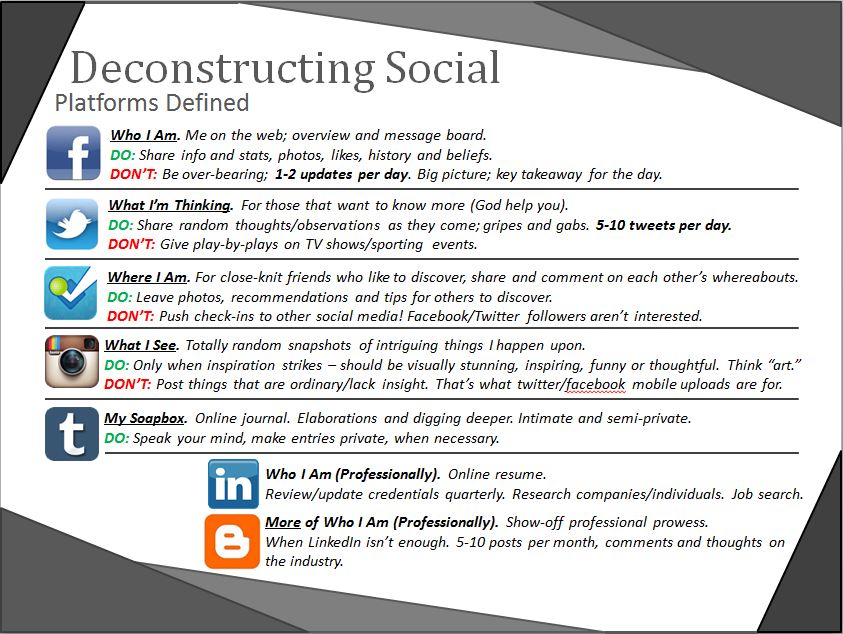
Whether you’re on all of these (and then some), or only a few, here’s how I try to think of each major platform holistically:

Customer Segmentation?

Exactly! It's Marketing 101. You have different things to share with each audience. When you think about it in these terms, you’re really engaging in (social media) target marketing.

Now let's take it a step further and discuss when you should and should not content across platforms.


Sensory overload, but fairly self-explanatory.

Something to remember about photos:

Disclaimer: I’m a HUGE fan of Instagram (especially as of late). Please forgive and take no offense at my passion-filled rant.

Instagram photos and mobile uploads to Twitter or Facebook are two very different things.

As broached in the first slide, 
Instagram IS visually stunning art and snapshots of everyday life. It's capturing moments spent with family and friends, nature's unyielding beauty, and the dramatic detail of architecture.

Instagram IS NOT you capturing a guy’s ass crack hanging out at the bar. It’s NOT the jewel case to the latest Resident Evil game for your XBOX. These are mobile uploads for Twitter or Facebook.

(And in BOTH cases, ALWAYS include a caption explaining why the hell you thought the image was worthy of sharing in the first place.)

The Two 'Nevers:'

Foursquare to Facebook

We discussed this a bit in our Facebook Resolutions post last year, but it bears repeating.

Nobody wins when you sync the two. If we want to know where you are, we’ll follow you on foursquare. If we’re already following you on foursquare, we don’t need to see your check-in on Facebook as well.

Fundamentally, foursquare is a game. People check in for points and to alert friends where they are. No one wants to see you bounce from point A to point B on Facebook with no further elaboration. It’s infuriating! 

Twitter to Facebook 

Why build a following on both just to be redundant?

New approach: Picture the various Social Media applications as different ticket packages to the same event – your (social media) life.

Twitter is front-row, exclusive/all access. These are your diehard fans; they can’t get enough of you.

Facebook is nose-bleed with obstructed view. These seats don’t get to see it all; they are adequate for followers with only a modest interest in you.

The people that sit in each of these sections expect very different experiences.

So give Facebook friends less and Twitter followers more; feeding only the BIGGEST of news to both.

Friday, January 13, 2012

Social Life Audit - (it's time you had yours)


Forget about Klout for a minute.
Ulitmat Vodka brings us the first-ever gauge of one’s offline social life.  

You may be cool on the web, but Ultimat contests that doesn’t immediately translate to the physical world (albeit, scores depend heavily on the content you post online – a bit of a contradiction, no?).
Let's get started!
How does it work?

The “Social Life Audit” (SLA) is a down and dirty breakdown of cool. Unlike Klout, which measures audience engagement and amplification by number of likes, comments, and retweets, SLA reviews the general make-up and quantity of friends tagged in posted photos and check-ins.

For example:

Mood Analysis uses Facebook’s built-in facial recognition API to gauge how much fun the people around you are having (smile vs. frown, eye contact).

Gender Analysis looks at male-to-female ratios, percentage of tags that are single and overall attractiveness (determined by facial expression).


What gets weighted?

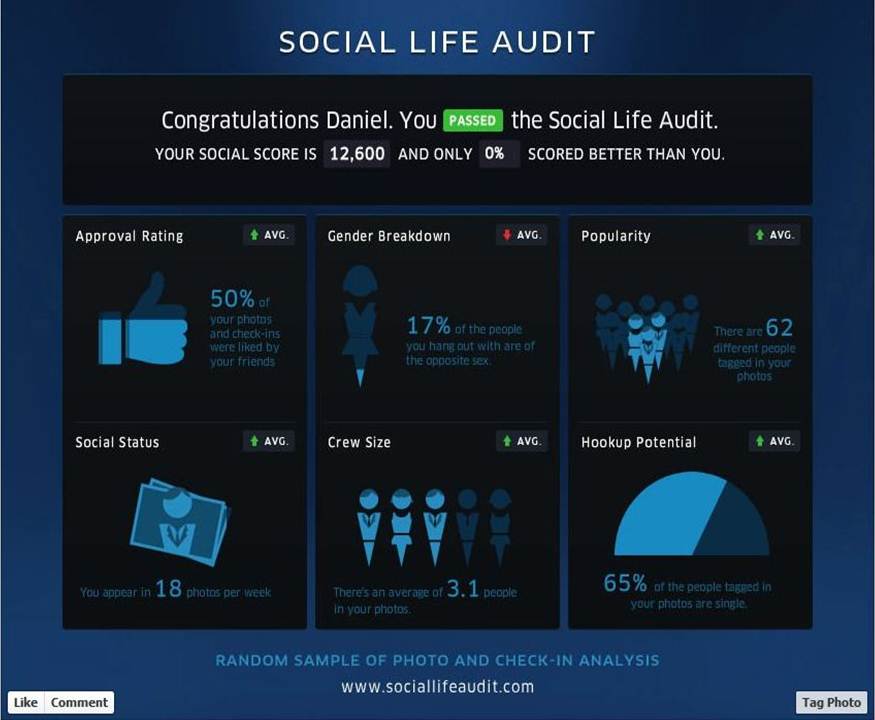
The audit takes into consideration:
  • Approval rating: (% of photos/check-ins that receive “likes”)
  • Gender Breakdown: (more points awarded for being with the opposite sex*)
  • Popularity: (based on total number of different people in your photos)
  • Social Status: (defined by the average number of photo tags per week)
  • Crew Size: (average number of people in your photos)
  •  “Hookup” Potential: (% of tagged people that are single – again, emphasis is on opposite sex*)
      *Unless you’re gay. Sorry, HRC. You can sit down now. Simply self-identify by clicking the gay/straight box and Ultimat recalculate’s your score. (Nice touch, guys!)

Here’s how I faired:
::shameless gloating::
But wait,
Where’s the marketing tie-in?

“Overworked? Under-played? Join the club.” –except from the site’s intro video.

It’s all part of Ulitmat Vodka’s new strategy; “Find Balance. Find Ultimat.” (We blogged about it last week, remember?) An interactive nugget of brand stickiness.

Ultimat wants to remind the ladder-climbing, workaholic in all of us to take a break. Get out from behind your computer and start living! That’s right, sign off Yammer and out of email. Close your laptop. And go crash the first Happy Hour you can find!

Work will wait for your return. Youth, maybe not. :P

Get your Social Media Audit here.
…what did it say? Let’s compare scores!